The JAIIB 2026 May cycle just ended. Whether you are planning to begin your preparation, already studying, or re-attempting for the JAIIB 2026 November cycle, going through the JAIIB previous year question paper should be your starting point.
As a banker with limited study time, JAIIB PYQs can save you effort.
Solving and analysing JAIIB previous year question paper with answers helps you understand the real JAIIB exam pattern, difficulty level, and important topics, allowing you to prepare smarter and score higher.
This article has the link to download JAIIB PYQs, how to use JAIIB previous year question paper and more.
How to Download JAIIB Previous Year Question Paper PDFs?
To download JAIIB previous year question papers with answer keys and detailed explanations in PDF format, click on the button below.
The JAIIB Previous Year Question Paper PDFs include:
- All 4 papers of 2026, 2025, 2024, and 2023:
- IE&IFS
- PPB
- AFM
- RBWM
- Complete questions with all four options, correct answer, and detailed explanation.
- Questions for which the topic and question type are known (exact wording not available).
- Difficulty level marked per question.
Important Note: These are memory-based PYQs because IIBF does not officially release question papers. Some questions may slightly differ from the actual exam as they are based on inputs from candidates who appeared for the exam.
- Important Topics
- Expected Questions
- Previous Year Papers
Are Chapter-wise and Module-wise JAIIB PYQs Available?
EduTap’s JAIIB Previous Year Paper document is organized paper-wise and module-wise, with questions tagged to their respective modules. This makes module-wise practice easy.
For example, after completing AFM Module C (Financial Management), you can go directly to the relevant section of the JAIIB PYQ PDF and practice the questions from that module.
Are JAIIB PYQs Available in Hindi?
EduTap’s JAIIB PYQ PDFs are in English. Since IIBF does not release official papers, Hindi PYQs are not widely available from any source.
The JAIIB exam is conducted in both Hindi and English, but memory-based reconstructions are compiled in English only.
How Many Years of JAIIB PYQs Should You Solve?
For the current exam, solving the last 4 to 5 cycles is the most effective approach:
Priority (must solve):
- JAIIB May 2026
- JAIIB Nov 2025
- JAIIB May 2025
- JAIIB Nov 2024
- JAIIB May 2024
Secondary (good to solve):
- JAIIB Nov 2023
- JAIIB May 2023 (first exam under new syllabus)
Pre-2023 papers can be used for AFM numerical practice and PPB banking operations, but should not be the primary source.
Do JAIIB Previous Year Questions Repeat?
Not word-for-word, but topics and frameworks repeat frequently.
What repeats in JAIIB:
- PPB: KYC definitions, NPA provisioning criteria, Ombudsman scheme limits and procedures, cheque crossing types, Negotiable Instruments Act questions. These appear in similar formats across multiple cycles.
- AFM: Numerical frameworks for ratio analysis, depreciation calculation using SLM and WDV, bond YTM questions. The same calculation approach is tested repeatedly, even if the numbers change.
- IE&IFS: Monetary policy tools, NBFC classification, insurance density and penetration concepts, RBI structure questions.
- RBWM: Credit scoring definitions, home loan product features, Recovery under SARFAESI.
Which Paper has the Most Repeated Content?
PPB. Banking operations and regulatory compliance topics: KYC, AML, NPA, Ombudsman, are asked in every cycle in some form.
A candidate who has studied PPB PYQs from 3 to 4 cycles will find the paper significantly easier on exam day.
- Important Topics
- Expected Questions
- Previous Year Papers
JAIIB Previous Year Papers Analysis
To save you time and effort, we have analyzed JAIIB previous year papers from the past 4 years across all four papers: IE&IFS, PPB, AFM, and RBWM.
Based on this analysis, we have identified the frequently tested topics and questions from each module. These topics can help you prioritize your revision and practice for the upcoming JAIIB exam.
Topic-wise Question Distribution
For the detailed topic-wise question distribution of each module, download the file linked below.
The downloaded document contains year-wise files, which are further organized cycle-wise. Open any cycle-wise file to find the paper-wise and module-wise analysis. After the detailed explanation of each module, you will find the topic-wise distribution of questions asked in that module.
JAIIB IE&IFS Important Topics
Module A
- Sunrise-Sunset Sector
- Priority Sector Lending
- MSMEs – criteria and schemes
- EASE Reforms
- Foreign Direct Investment (FDI) – types and routes
- FII – features
- International Economic Organizations – IMF
- Corporate Social Responsibility (CSR)
- Sustainable Development Goals (SDGs)
- FERA
Module B
- Limitations of Microeconomics
- Measures of Money Supply and the Role of RBI
- GDP Deflator
- IS-LM Theory
- Phases of Business Cycles
- Budget Deficits
- Government Revenue and Expenditure
- Monetary Policy Committee and Monetary Policy Tools
- GDP Concepts
- Demand and Supply Curves and Their Shifts
Module C
- Initial Sections of the Reserve Bank of India Act, 1934 and Banking Regulation Act, 1949
- Features of Development Financial Institutions
- National Bank for Financing Infrastructure and Development (NaBFID)
- National Asset Reconstruction Company (NARCL)
- Types of Non-Banking Financial Companies (NBFCs)
- Bancassurance and Reinsurance
- IRDAI Members
- EASE Reforms
- Payment Settlement System – NACH
- Insurance and Pension Regulators
Module D
- Notice Money, Certificate of Deposit (CD), Commercial Paper and Bill Rediscounting Scheme (BRDS)
- Government Securities in India and Corporate Bond Market
- RBI Retail Direct Scheme (RDS)
- Forex Markets
- FX-Retail Platform
- Merchant Banking
- Factoring
- Trade Receivables Discounting System (TReDS)
- Types of Leasing
- Mutual Funds – CAGR Calculation and Types
- Government Initiatives Related to Insurance
- Types of Infrastructure Investment Trusts (InvITs)
- Primary Dealers
- Credit Rating Agencies
- Depositories
- Para-Banking
- Hire Purchase
JAIIB PPB Important Topics
Module A
- Banker-Customer Relationship
- Deposit Accounts and Foreign Currency Accounts for Residents
- Accounts of Individuals and Other Customers
- Negotiable Instruments
- Operational Aspects of KYC
- Banker’s Special Relationship
- RBI IOS 2021
- CTS
- NRI Accounts
Module B
- Types of Borrowers
- Types of Credit Facilities
- Assessment of Working Capital
- Types of Charges
- Priority Sector Lending
- Bank Finance to NBFCs
- Non-Performing Assets (NPAs)
- Interest Rates on Loans
- Principles of Lending
- IBC, 2016
- Letter of Credit
- Government-Sponsored Schemes
- Bill Finance
- Bank Guarantee
Module C
- Networking Technologies in Banks
- Automated Teller Machines (ATMs)
- Electronic Payment Systems in India
- NPCI
- Core Banking Solutions
Module D
- Ethics and Business Values
- Values, Norms and Beliefs
- Personal Ethics and Business Ethics
- Work Ethics and Workplace Ethics
- Important Topics
- Expected Questions
- Previous Year Papers
JAIIB AFM Important Topics
Module A
- Definition, Scope and Accounting Standards, including Ind AS
- Rules of Debit and Credit
- Rectification of Errors and Types of Errors
- Bank Reconciliation Statement
- Different Methods of Depreciation
- Capital and Revenue Expenditure
- Important Terms Related to Bills of Exchange
- Types of Audit
Module B
- Preparation of Balance Sheet and Profit & Loss Account
- Cost of Goods Sold
- Definition and Types of Companies
- Balance Sheet
- Components of Cash Flow
- Disclosure Requirements
- Computerised Accounting
Module C
- Different Types of Ratios
- Simple and Compound Interest Calculations
- Annuity
- EMI Calculation
- Bond Theorems and Bond Price Volatility
- Intrinsic Value of a Bond
- Types of Leases
- Working Capital
Module D
- TCS, TDS and Deductions
- GST Provisions
- Profit-Volume Ratio
- Break-Even Point
- Margin of Safety
- Normal and Abnormal Loss
- Costing and Types of Costing
- Types of Budgets
JAIIB RBWM Important Topics
Module A
- Characteristics of Retail Banking
- Branch Profitability
- Branch Operating Efficiency
- Nationalisation of Banks
- Gross Profit
- SBU Approach
- Departmental Approach
- Horizontal Organised Model
- ROA and ROE
- Banking System in India
Module B
- Maslow’s Theory
- Product Life Cycle
- Basic Savings Bank Deposit Account
- Small Account
- Minor Account
- CKYCR
- Savings Account
- Education Loan
- NPCI
- NEFT
- IDRBT
- SFMS
- SWIFT
- NFS
- MIS
- MRR
- SARFAESI Act
- Current Account Documentation
- Artificial Intelligence
- Credit Scoring
- Credit History
- UPI
- SMA Accounts
- Blockchain Technology
- Credit Cards
- Fixed Deposits
- PMAY
- Current Account
- Provisioning of Substandard Assets
Module C
- 7 Ps of Marketing
- UPI
- Unauthorised Electronic Transfer
- CPED
- MKIS
- White Label ATM
- ATM Withdrawal
- POS
- CRM
- BSCBI
Module D
- Mutual Funds
- Wealth Management Solutions
- Underwriting
- Portfolio Management Services
- Income Tax
- Long-Term Capital Gains Tax
- Pradhan Mantri Suraksha Bima Yojana
- Pradhan Mantri Vaya Vandana Yojana
Module E
- Rule of 72, 115 and 144
- Sinking Fund
- Reverse Mortgage Loan
- Depreciation
- Valuation of Land
- Mortgage
- Compounding
- Time Value of Money
- Annuity
Why are JAIIB PYQ Important for Your Preparation?
If you plan to solve JAIIB previous year question papers only after completing the entire JAIIB syllabus, you’re making a big mistake.
JAIIB PYQs should be your starting point, not your final step. They give you clarity, direction, and focus from day one.
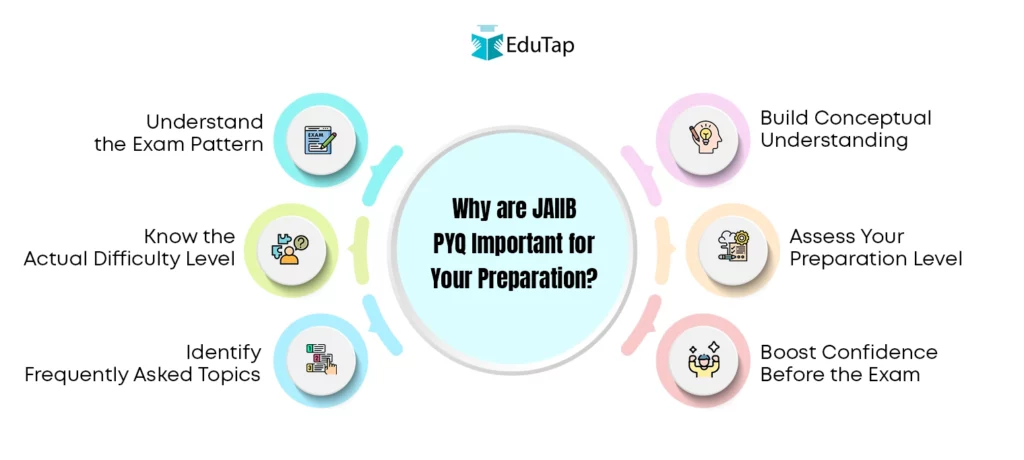
Solving IIBF JAIIB previous year papers helps you:
1. Understand the Exam Pattern
- JAIIB PYQs help you understand how the questions are framed, the type of options given, and the overall structure of the exam.
2. Know the Actual Difficulty Level
- Instead of guessing the toughness of the paper, PYQs show you the real level of questions set by IIBF.
3. Identify Frequently Asked Topics
- Not every module or topic carries the same importance.
- JAIIB PYQs help you identify which modules and topics are asked most frequently, so you don’t waste time on low-weightage or irrelevant areas.
4. Build Conceptual Understanding
- By solving JAIIB previous year question papers, you learn how concepts are applied in real exam scenarios, not just theoretically.
5. Assess Your Preparation Level
- Attempting JAIIB PYQs under timed conditions helps you improve your speed, accuracy, time management, and decision-making skills.
6. Boost Confidence Before the Exam
- Knowing you’ve solved actual JAIIB exam questions makes you feel more prepared and reduces exam-day anxiety.
- Important Topics
- Expected Questions
- Previous Year Papers
How to Use JAIIB Previous Year Question Papers Effectively?
Now that you know why PYQs are so valuable, let’s talk about how you can actually use them to level up your preparation:
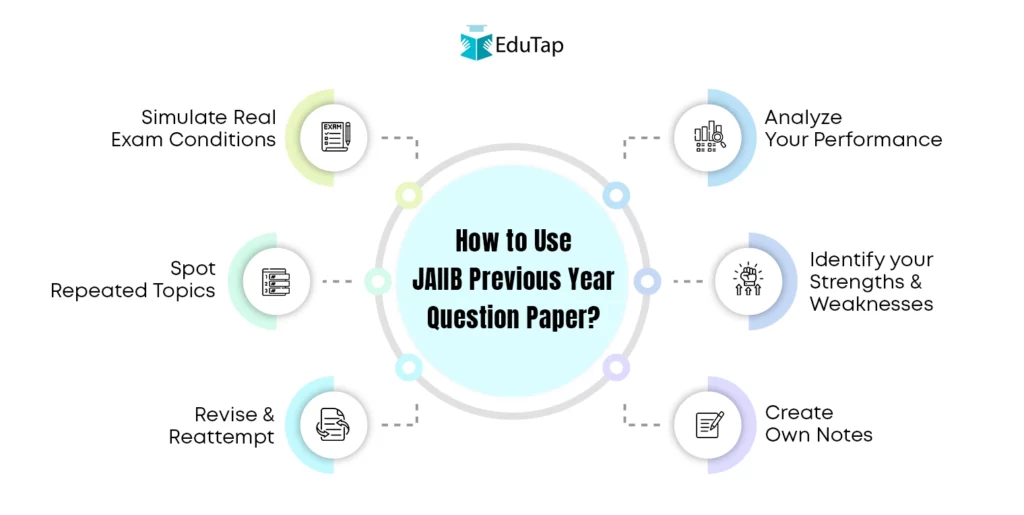
1. Simulate Real Exam Conditions
- Attempt each paper (IE&IFS, PPB, AFM, and RBWM) in one go by simulating a real exam environment:
- Set a timer
- Avoid breaks
- Don’t check answers midway
- This improves your speed, accuracy, and time management.
2. Analyze Your Performance
- After each JAIIB PYQ practice, you must check the answers and identify:
- Why did you get the answer wrong?
- Was it a lack of concept clarity?
- Was it a calculation error?
- Did you misread the question?
- Fixing these mistakes prevents you from repeating them in the actual exam.
3. Spot Repeated Topics
- Note down the repeated topics that consistently appear across different JAIIB cycles.
- Prioritize these topics in your study plan, as they give maximum return for your effort.
4. Identify your Strengths and Weaknesses
- Analysing JAIIB PYQs reveals your mistakes and helps you identify your strong topics and which ones need improvement.
- Use this insight to:
- Focus more on weak areas
- Solidify your strong areas
5. Revise and Reattempt
- After analysing mistakes, revisit the related concepts and revise them thoroughly.
- Reattempt the same PYQs after a few days to:
- Check whether you truly learned the concept
- Improve retention
- Reduce repeated mistakes
6. Create Own Notes
- Create a dedicated notebook to note down:
- Tricky questions
- Repeated mistakes
- Frequently asked definitions
- Important shortcuts/formulas
When Should You Start Solving PYQs?
From the first week of preparation. Start with one paper’s worth of PYQs before beginning full preparation.
This gives a basic idea of the exam’s nature, difficulty, and question format before you invest time in any specific module.
Can You Clear JAIIB Using Only PYQs?
No. PYQs help you understand patterns and identify high-frequency topics. They do not cover the full syllabus.
A candidate who only solves PYQs without reading the IIBF books risks:
- Missing entire modules that have not appeared in recent cycles.
- Lacking conceptual depth for statement-based and analytical questions.
- Being unprepared for new topic additions that IIBF may introduce.
PYQs are not a replacement for syllabus coverage.
Are Old JAIIB PYQs Still Relevant After the Syllabus Change?
No. Pre-2023 JAIIB PYQs are not relevant for the current exam.
IIBF revised the JAIIB syllabus in 2023. The structure changed from 3 papers to 4 papers.
Two of the current papers, IE&IFS and RBWM, did not exist before 2023. The third paper, Legal and Regulatory Aspects of Banking (LRAB), was removed from the syllabus entirely.
PPB and AFM carry over from the old structure but were significantly revised. The old paper was called “Accounting and Finance for Bankers”, not AFM.
The content overlap exists, but the scope and framing have changed.
JAIIB PYQs vs Mock Tests: Which Is More Important?
Both serve different purposes.
| IIBF JAIIB PYQs vs Mock Test | ||
| JAIIB PYQs | JAIIB Mock Tests | |
| What Do They Test? | Actual IIBF question style | Full syllabus coverage under time pressure |
| Best Use | Identifying important topics, learning question patterns | Building speed, accuracy, exam stamina |
| When to Use | Throughout preparation. Module by Module | Final 4 to 6 weeks. Full paper attempts |
Can Mock Tests Replace JAIIB PYQs?
No, JAIIB mock tests should not replace PYQs. As shown in the table above, both serve different purposes.
- PYQs help you understand the actual exam pattern, question types, difficulty level, and frequently tested topics.
- Mock tests help you practice, improve speed and accuracy, and simulate the exam environment.
The best approach is to solve PYQs first to understand what the exam asks, and then use mock tests for additional practice and revision.
PYQs or Mocks: Which One to Start With?
JAIIB previous year question paper PDF first. Solve the most recent cycle (May 2026) before starting full preparation.
This gives you a reference point. Then begin syllabus coverage. Then move to full mock tests in the final weeks.
Mock tests test coverage. PYQs reveal style and the actual JAIIB paper pattern. Both are needed
- Important Topics
- Expected Questions
- Previous Year Papers
Mistakes to Avoid While Solving JAIIB PYQs
- Solving too many at once: 100 questions in one sitting without analysis reduces retention. Quality of practice matters more than quantity.
- Solving without a timer: PYQs solved without time pressure do not build the exam stamina you need. Set a timer every time.
- Skipping analysis: Getting an answer right without understanding why is worth almost nothing. Analysis is where learning happens.
- Treating PYQs as the only preparation: Relying on PYQs alone leaves too many syllabus areas uncovered.
- Solving only recent cycles: For PPB and AFM, older cycles have overlapping content that reinforces fundamentals. Do not ignore them entirely.
- Not revising wrong answers: Candidates who mark wrong answers and move on will repeat the same errors in the actual exam.