Current affairs play a crucial role in your NABARD Grade A preparation for both Phase 1 and Phase 2, as they can make or break your score. Yet this section is also the one that confuses most aspirants. You might be asking yourself:
- How should I prepare current affairs for NABARD Grade A?
- Which are the best and most reliable sources?
- How many months of current affairs should I cover?
- What topics are actually relevant for NABARD?
You’re not alone. Almost every serious aspirant feels the same way at this stage.
But don’t worry!
In this article, you’ll get practical answers to all your current affairs doubts, along with smart strategies to prepare current affairs topics effectively for the NABARD Grade A exam.
Why Current Affairs Matter in NABARD Grade A
You simply can’t afford to ignore current affairs for NABARD because they are tested in every phase of the exam—Phase 1, Phase 2, and the interview.
1. Phase 1 (Prelims)
- Current Affairs is part of the merit section (GA, ESI, and ARD), which decides whether you qualify for Phase 2.
2. Phase 2 (Mains)
Current affairs appear in both papers:
- Paper 1 (English Descriptive): Using the latest facts, figures, and statistics makes your essays and letters more relevant and impactful.
- Paper 2 (ESI & ARD): Most objective questions come directly from recent schemes, reports, and government data. Even in descriptive questions, referring to current developments makes your answers stand out.
3. Interview
In the interview, you may be asked about:
- Recent developments in agriculture, the economy, or rural banking
- New government schemes or initiatives
- Your opinion on current economic and social issues
- Eligibility
- Pattern
- Syllabus
- Solved PYQs
- Strategy
What to Prioritize in NABARD Grade A Current Affairs?
Here are the key current affairs topics you should prioritize while preparing for NABARD Grade A:
- Government Schemes
- Latest Development/ Events related to Syllabus
- Reports, Rankings, and Indices
Let’s go through each one step by step.
1. Government Schemes
Government schemes are the most important area for the NABARD Grade A exam. Questions on schemes are asked in both Phase 1 and Phase 2. This is because most NABARD objectives revolve around rural and agricultural development, which are directly linked to these schemes.
Here are the number of questions asked from government schemes in NABARD Grade A Phase 1 and 2 over the past 3 years:
| NABARD Grade A Phase 1 Government Schemes Asked in the Past 3 Exams | |||
| Subjects | 2022 | 2023 | 2024 |
| ESI | 16 Marks | 23 Marks | 14 Marks |
| ARD | 2 Marks | 5 Marks | 4 Marks |
| GA | 1 Mark | 2 Marks | 4 Marks |
| Total Questions | 19 Marks | 30 Marks | 22 Marks |
| NABARD Grade A Phase 2 Government Schemes Asked in the Past 3 Exams | |||
| Paper 2 | 2022 | 2023 | 2024 |
| Objective | 25 Marks | 14 Marks | 18 Marks |
| Descriptive | 25 Marks | 0 Marks | 10 Marks |
| Total Questions | 50 Marks | 14 Marks | 28 Marks |
Which Government Schemes to Cover?
Although every scheme mentioned in the syllabus is important, you should prioritise those schemes which are currently in the news, such as:
- MGNREGA
- NRLM
- Rural housing
- Swachh Bharat Mission
- Jal Jeevan Mission (JJM)
Here are some actual government scheme-based questions (which were in the latest news) asked in the past NABARD Grade A exam:
| NABARD Grade A Government Schemes Questions Asked in 2024 | |
| Phase/ Subject | Question |
| Phase 1 GA | In April 2024, the Government of India released the “ CDP-Suraksha” under the Cluster Development Scheme. Which of the following are the objectives or features of the Cluster Development Scheme? |
| Phase 1 ESI | Ministry of Skill Development and Entrepreneurship (MSDE) is implementing its flagship scheme Pradhan Mantri Kaushal Vikas Yojna (PMKVY), since 2015, for imparting skill development training, The Duration of short-term training (STT) courses is ________ under the PMKVY 4.0. |
| Phase 1 ARD | Which of the following are eligible beneficiaries under the PMAY-G scheme? |
| Phase 2 Objective | Para based on PMJUGA and PMJANMAN Which one of the following are the goals of the scheme ____X_____mentioned in the passage? |
| Phase 2 Descriptive | What are the objectives and aims of the PM Vishwakarma and SVAMITVA schemes? |
How to Cover Government Schemes?
Here are the specific elements of government schemes that you must cover for Phase 1 and Phase 2:
- Identify the Scheme
- Eligible Beneficiaries
- Nodal Ministry
- Launch Year
- Funding Pattern (Center/State)
- Objectives
- Budget Allocation
- Current developments
- Tagline
- Associate Company for Implementation
- Associate Brand Ambassadors

Here are some actual questions asked in previous NABARD Grade A exams based on the key elements as mentioned above:
- Eligible Beneficiaries
- Which of the following are eligible beneficiaries under the PMAY-G scheme? (2024)
- Objectives
- Ministry of Skill Development and Entrepreneurship (MSDE) is implementing its flagship scheme Pradhan Mantri Kaushal Vikas Yojna (PMKVY), since 2015, for imparting skill development training, The Duration of short-term training (STT) courses is ________ under the PMKVY 4.0. (2024)
- Eligibility
- Pattern
- Syllabus
- Solved PYQs
- Strategy
2. Latest Development/Events related to Syllabus
Latest developments and events should be your 2nd priority while preparing for the NABARD Grade A current affairs.
Here are the number of questions asked from the Latest Development/Events in NABARD Grade A Phase 1 and 2 over the past 3 years:
| NABARD Grade A Phase 1 Questions Asked on the Latest Development/Events | |||
| Subjects | 2022 | 2023 | 2024 |
| ESI | 8 Marks | 8 Marks | 17 Marks |
| ARD | 3 Marks | 5 Marks | 4 Marks |
| GA | 17 Mark | 18 Marks | 13 Marks |
| Total Questions | 28 Marks | 31 Marks | 34 Marks |
Actual latest developments and events-based questions asked in the past NABARD Grade A exam:
| NABARD Grade A Latest Developments/Events-based Questions Asked in 2024 | |
| Topic | Question |
| ESI | As per the information from the Data Dissemination Portal of the Directorate General of Commercial Intelligence and Statistics (DSCIS), the share of export of MSME specified products in all India exports during 2023-34 was _____% (to the nearest approximation). |
| ARD | NABARD has the unique distinction of being accredited as the National Implementing Entity (NIE)/ Direct Implementing Entity (DIE) of which of the following funds is attributed to climate change? |
| Finance | As per the extant guidelines of SEBI, what is the minimum amount that can be accepted as investment from the investor under the Alternative Investment Fund (Other than angel funds)? |
3. Reports, Rankings, and Indices
Only a few questions are usually asked from reports, rankings, and indices, but you should not ignore them completely. Even though the weightage is small, these questions are easy to score if you revise regularly.
That’s why I’ve kept this topic as the 3rd priority.
| NABARD Grade A Phase 1 Reports Asked in the Past 3 Exams | |||
| Subjects | 2022 | 2023 | 2024 |
| ESI | 12 Marks | 3 Marks | 6 Marks |
| ARD | 2 Marks | 0 Marks | 0 Marks |
| GA | 1 Mark | 0 Marks | 0 Marks |
| Total Questions | 15 Marks | 3 Marks | 6 Marks |
| NABARD Grade A Phase 2 Reports Asked in the Past 3 Exams | |||
| Paper 2 | 2022 | 2023 | 2024 |
| Objective | 4 Marks | 0 Marks | 9 Marks |
| Descriptive | 0 Marks | 0 Marks | 0 Marks |
| Total Questions | 4 Marks | 0 Marks | 9 Marks |
Which Reports to Cover?
Here are some important reports that you should cover:
- For ESI
- National & International Reports
- Census
- SECC
- National Educational Policy
- ARD
- NABARD Annual Report
- Handloom Census
- Basic Animal Husbandry Statistics
- Agri Census
Important Note: NABARD generally does not ask questions on reports released by private organizations.
Now that you know what to read, it’s time to look at the high-weightage topics you should prioritize in your NABARD Grade A preparation.
- Eligibility
- Pattern
- Syllabus
- Solved PYQs
- Strategy
What are the Important Current Affairs Topics?
Below, I have mentioned the subject-wise important topics that you should prioritize:
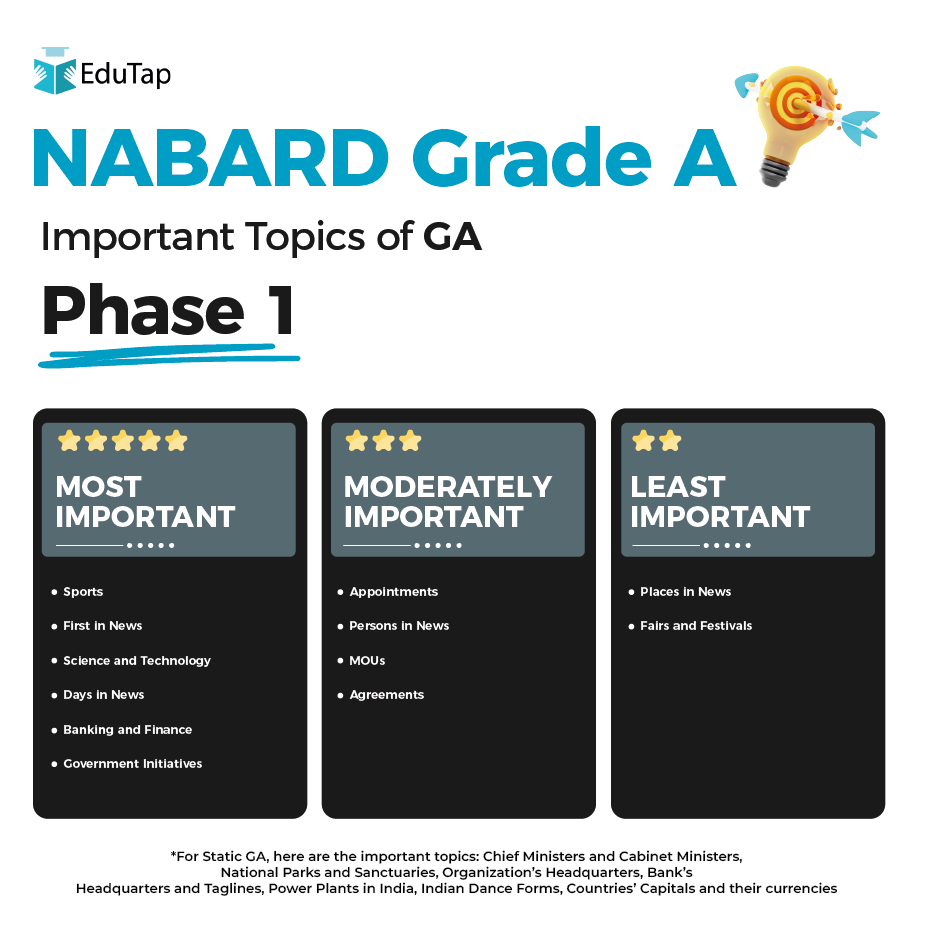
Important General Awareness Current Affairs Topics: Phase 1
Here are the important GA current affairs topics:
- First in News
- Government Initiatives
- MOUs and Agreements, Partnerships and Alliances
- Summits and Conferences
- Science and Technology
- Defence Exercises
- Environment
- Sports
- Awards and milestones
- Days in News
- Books and Authors
- Places in News
- Fairs and Festivals
- Appointments
Important ESI Current Affairs Topics: Phase 1 + 2
Here is the list of topics that you must prepare for ESI Current Affairs:
- Flagship Economic Development Schemes: PM-SYM, PMJDY, PMJJBY, PMSBY, PMMY, Stand Up India, DDU-GKY, PMEGP, Production-Linked Incentive (PLI) Scheme
- Books and Authors
- Defence: Military Exercises, Equipment
- MoUs + Funding, Banks, Alliance, Membership
- Person in News: Awards, Appointments, Obituaries
- First in News (For ex: an initiative taken for the first time, a national organization’s first event, etc.)
- Summits and Conference
- Current Affairs: Environment and Ecology
- Data by Important Institutes: NITI Aayog, RBI, NABARD, WTO, WB, IMF, ADB, etc.

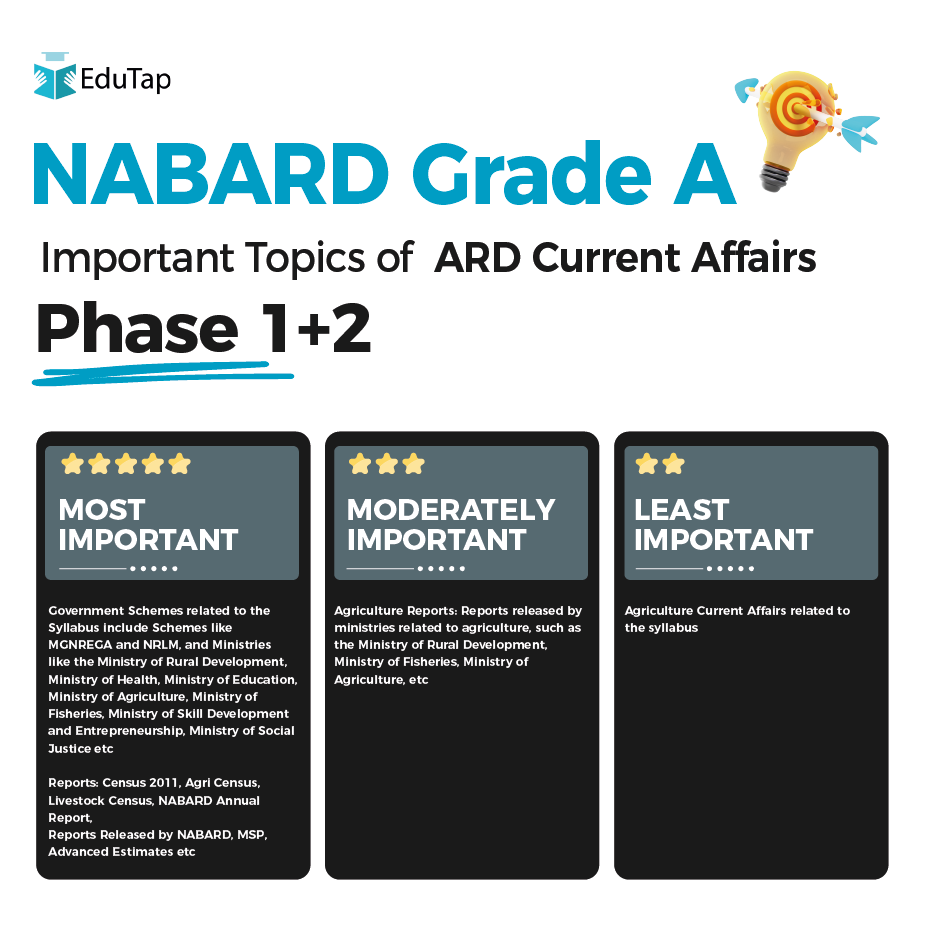
Important ARD Current Affairs Topics: Phase 1 + 2
Here I am sharing with you the list of important ARD current affairs topics that you must prepare for the NABARD Grade A exam:
- ARD Schemes of the last 6 months
- Flagship Agriculture Schemes (AIF, PMKSY, PMFBY, PM-KMY, e-NAM, KCC, SHC, PMMSY, NHM)
- Flagship Rural Development Schemes: PMAY-G, PMGSY, NRuM, MGNREGA, JJM, NRLM, DDUGKY
- Census: 2011, SECC, Livestock, Agriculture
- Annual Reports: MoA&FW, AH&D, NABARD, and MSP
- Latest Union Budget
- Latest Economic Survey
- Indian State of Forest Report
- Key Stats of Cooperative Banks
Till now, we have covered what to cover and what to prioritise. Now, let’s find out the best resources to prepare from.
What Are the Best Current Affairs Resources for NABARD Grade A?
Here are the best resources for the NAABRD Grade A current Affairs preparation:

- Press Information Bureau
- The Hindu
- The Economic Times
- Official Website of NABARD
- Vikaspedia
- Krishi Jagran
Does EduTap Provide Resources for NABARD Grade A Current Affairs?
Yes, at EduTap, you’ll find multiple current affairs resources to prepare for the NABAED Grade A exam, such as:
- CurrentTap (GA + ESI + Finance)
- Covers relevant national and international news, including updates on RBI and the banking system.
- CurrentTap (Agriculture):
- Focuses on key agriculture and rural development updates.
- SchemesTap (Government Schemes):
- Explains all major government schemes with their objectives, ministries, and benefits.
- ReportsTap (Reports and Indices):
- Summarizes key reports and indices released by national and international organizations.

EduTap Free Study Material
Following is a list of EduTap’s YouTube playlists beneficial for comprehensive coverage of Current Affairs.
| EduTap Free Study Material | |
| Current Affairs Topic (Phase 1 + 2) | Link |
| NABARD GA + ESI Current Affairs | Watch Now |
| NABARD ARD Current Affairs | Watch Now |
| NABARD Government Schemes | Watch Now |
| NABARD Finance Current Affairs | Watch Now |
You got what to cover, how to cover, and from where to cover current affairs, but do you know how much to cover?
Let’s find out.
How Many Months of Current Affairs Do You Need to Cover?
For Phase 1
- Ideally, you should cover the last 5–6 months of current affairs.
- However, most of the questions in NABARD Grade A Phase 1 come from the last 3 months, so start with those first and then move backward.
| NABARD Grade A Phase 1 Current Affairs Questions | |||
| Subject | 3 Months Before | 4-5 Months | Beyond 5 Months |
| ESI | 33 Questions | 1 Questions | 3 Questions |
| ARD | 4 Questions | 0 Questions | 1 Questions |
| GA | 5 Questions | 3 Questions | 3 Questions |
For Phase 2
- Aim to cover 8 months of current affairs before the exam.
- Since you’ve already prepared for 6 months for Phase 1, you only need to:
- Cover the latest news between Phase 1 and Phase 2.
- Revise the previous 6 months thoroughly.
| NABARD Grade A Phase 2 Current Affairs Questions | ||
| Subject | 6-8 Months | Beyond 8 Months |
| ESI + ARD | 13 Questions | 4 Questions |
Final Thoughts
Now that you know what to study, how to prepare, where to read from, and how much to prepare for NABARD Grade A current affairs, here are a few actionable tips to help you stay on track:
- Read current affairs for 30–45 minutes every day without skipping.
- Cover the last 5–6 months of updates and focus more on the latest 3 months.
- Prioritize Government Schemes, then focus on ESI/ARD Developments and Reports.
- Use one reliable source instead of following too many.
- Revise regularly to improve retention.
- Create short notes or one-liners for quick revision.
- Practice MCQs weekly to strengthen recall and identify weak areas.
- Note down important facts, data, and statistics, and use them in your descriptive answers to make them more impactful.