After successfully clearing Phase 1 and 2, you’ll reach the RBI Grade B interview stage. With 20% weightage in the final selection, the RBI Grade B interview plays a significant role in the overall recruitment process.
At the RBI Grade B interview stage, many aspirants, like you, feel unsure about the interview schedule, what to prepare, and what to expect from the interview panel.
In this article, I’ll explain the complete RBI Grade B interview process, including key dates, centers, expected questions, how to fill the biodata form/DAF, and important instructions.
What is the RBI Grade B Interview Pattern?
The RBI Grade B interview pattern includes 2 parts, both of which are mandatory for candidates shortlisted after Phase 2:
- Psychometric test
- Interview
Let’s discuss the key details of each.
RBI Grade B Psychometric Test Pattern
The Psychometric Test is a pre-interview assessment tool used by RBI to understand your personality traits, behavioural tendencies, and decision-making style.

- Mode: Conducted online
- Access: You’ll receive a link via email
- Location: Can be attempted at your convenience
- Language: You can choose from English and 9 other Indian languages
- Questions: Usually 100 to 120 questions
- Duration: There is no fixed duration
- Marks: No marks are allotted
Important Notes:
- The Psychometric Test does not impact the final score directly.
- It contains behavioural and situational questions and is used only to provide inputs to the interview panel.
- Once submitted, you cannot reattempt the Psychometric test.
RBI Grade B Interview Pattern
The RBI Grade B interview evaluates your conceptual clarity, communication skills, confidence, attitude, and suitability for a central banking role.

- Mode: Conducted in person (offline)
- Location: Conducted at multiple interview centres
- Interview centre: Mentioned in the interview call letter
- Language: You can choose either Hindi or English (no regional languages)
- Questions: Not fixed; they depend on the panel’s discussion
- Duration: No fixed duration; generally lasts between 20 and 45 minutes
- Marks: Conducted for a total of 75 marks
- Cut-off marks: Decided by RBI
- Negative marking: Not applicable
Weightage of the RBI Grade B Interview
The final selection is based on a combined score with the following weightage:
- 80% weightage: Phase 2
- 20% weightage: Interview
Phase 1 is qualifying in nature and does not carry any weightage in the final merit list.
How Many Aspirants Are Called for the RBI Grade B Interview?
RBI generally calls around 3 times the number of vacancies for the interview stage.
This means approximately 3 candidates are interviewed for each vacancy.
- Mock Interview
- Online & Offline Options
- Experienced Panel
- Email & Phone Support
What Is the RBI Grade B Interview Syllabus?
The RBI Grade B Interview does not have a fixed or predefined syllabus. Instead, the interview is broad-based and dynamic, focusing on assessing your knowledge, analytical ability, and personality.
Below are the key areas from which the interview panel commonly asks questions:
1. Knowledge About RBI
- Functions and objectives of the Reserve Bank of India
- Recent initiatives, policy actions, and regulatory measures taken by RBI
- RBI’s role in maintaining financial stability, regulation, and supervision
2. Economics, Finance, and Banking
- Indian economy: growth trends, inflation, fiscal policy, and monetary policy
- Banking system in India and major financial sector reforms
- Financial markets, financial inclusion, and digital payment systems
- Awareness of global economic developments and their impact on India
3. Current Affairs (Focus on Economy & Finance)
- Recent national and global economic developments
- RBI policies, circulars, reports, and announcements
- Government schemes related to the economy, banking, and finance
- Global institutions like the IMF, World Bank, and their relevance to India
4. Biodata Form/DAF-Based Questions
- Graduation and post-graduation subjects
- Conceptual clarity in core subjects studied
- Ability to apply academic knowledge to real-world scenarios
- Role and responsibilities in current or previous employment (If applicable)
5. Personality and Behavioural Assessment
- Decision-making ability
- Ethical orientation and integrity
- Stress management and adaptability
- Leadership potential and teamwork
6. Opinion-Based and Situational Questions
- Views on current economic, financial, or policy issues
- Responses to hypothetical workplace or policy-related situations
- Judgement, reasoning, and clarity of thought under pressure
RBI Grade B Interview: Complete Timeline
Based on previous recruitment cycles, the RBI Grade B interview process follows a structured timeline after Phase 2:
Phase 2 Exam → Phase 2 Result → Biodata Form (DAF) Filling Begins → Biodata Form (DAF) Submission → Interview Date Announcement → Interview Call Letter Release → Interviews Begin → Interviews Conclude → Final Result.
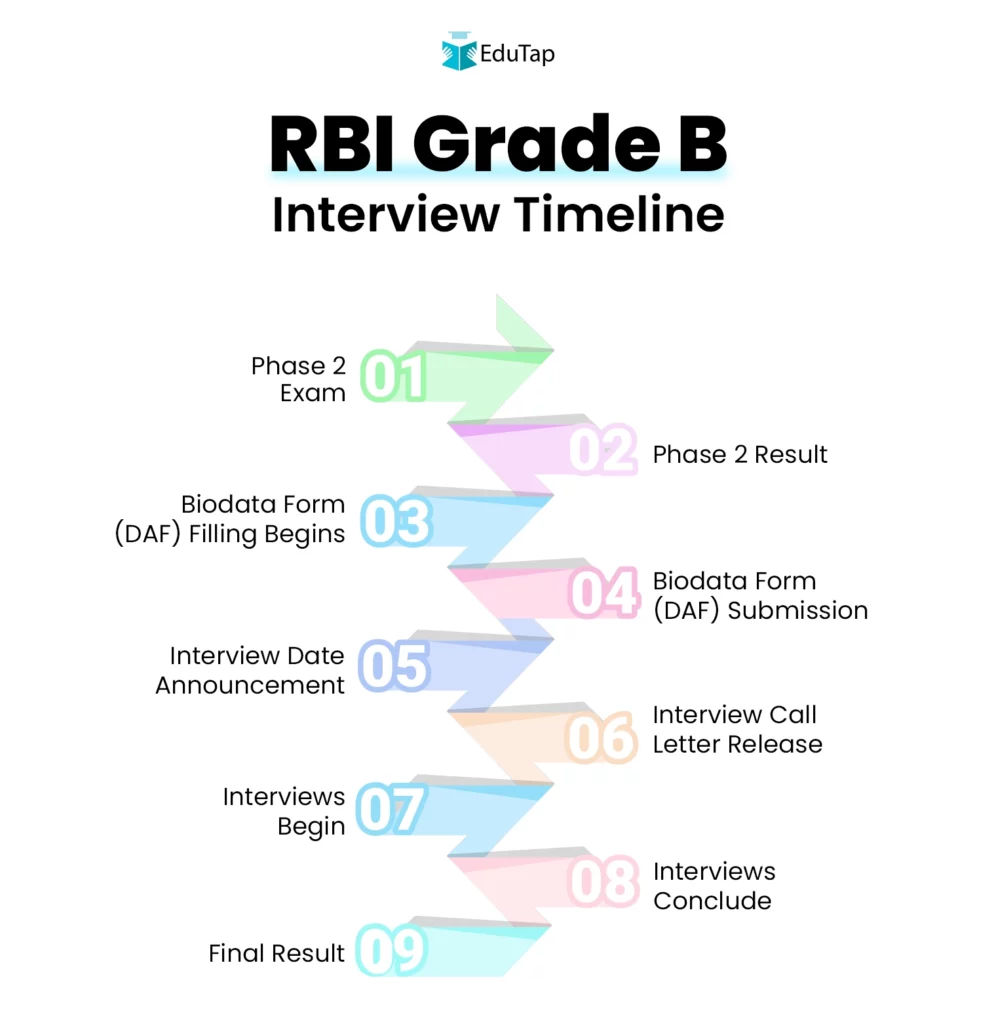
The entire process from the Phase 2 result to the final result generally takes around 2-3 months. For your reference:
RBI Grade B Interview Timeline
- 2026 Phase 2 Result: 22 August 2026
- 2026 Final Result: 15 October 2026
- 2025 Phase 2 Result: 19 January 2026
- 2025 Final Result: 24 March 2026
- 2024 Phase 2 Result: 14 November 2024
- 2024 Final Result: 11 February 2025
This confirms the usual 2-3 month interview cycle.
Here is the usual time gap between each stage:
| RBI Grade B Interview Timeline | |
| Stage | Duration (Approx) |
| Phase 2 to Phase 2 result | 3-4 Weeks |
| Phase 2 Result to Start of Biodata form (DAF) Filling | Same Day |
| Start of Biodata form (DAF) Filing to Last Date of Submission | 7-10 Days |
| Biodata form (DAF) Submission to Interview Date Notice | 2-3 Weeks |
| Interview Date Notice to Release of Call Letter | 5-7 Days |
| Release of Call Letter to Interview Start | 7-10 Days |
| Interview Start to Last Interview Day | 2-3 Weeks |
| Interview to Final Result | 3-4 Weeks |
Important Note: Document verification is done on the interview day, before the interview starts.
RBI Grade B 2027 Interview Dates
The RBI Grade B 2027 interviews are expected to be held around September–October 2027, assuming the notification is released between April and June 2027.
Check your registered email ID to download your RBI Grade B interview call letter and check your interview details.
What is the RBI Grade B Interview Day Timeline?
Below, I have mentioned the complete timeline of the RBI Grade B interview day:
1. Reporting Time
- There are 2 slots for the RBI Grade B interview:
- Morning Slot: 9:00 AM
- Afternoon Slot: 1:00 PM
2. Waiting Period
- You may have to wait between 30 minutes and 3 hours, depending on:
- Your sequence in the interview slot
- The pace of the interview panel
3. Interview Duration
- The interview generally lasts 20 to 45 minutes, based on:
- The depth of discussion
- The nature of the questions asked by the interview board
Important RBI Grade B Interview Instructions
- You must report as per the time mentioned on the interview call letter.
- It is advisable to reach 30-45 minutes early to complete formalities smoothly.
Can You Leave After Your Interview?
- Yes. Once your interview and document verification are complete, you are free to leave.
Can You Reschedule Your RBI Grade B Interview?
- Rescheduling is not permitted under any circumstances.
- You must appear only on the date and time mentioned in your call letter.
How to Download the RBI Grade B Interview Call Letter?
If you have cleared the Phase 2 examination, RBI will send your Interview Call Letter directly to your registered email ID.
Steps to Download Your RBI Grade B Interview Call Letter
- Check your registered email inbox for the interview call letter email from RBI.
- Download the PDF attachment provided in the email.
- If the email is not visible, check your spam or promotions folder.
- Take a printout of your call letter.
- Carefully verify details such as interview date, time, venue, and required documents.
Release Timeline of the RBI Grade B Interview Call Letter?
- The RBI Grade B interview call letter (admit card) is usually sent 2-3 weeks before the interview date.
- You’ll also receive an SMS alert once the call letter is issued.
Important Notes:
- No download link is provided on the RBI website.
- The call letter is not sent by post.
- A printed copy of the call letter is mandatory at the interview venue.
- Digital copies are not accepted.
- Both black-and-white and colour printouts are valid.
- If you’re unable to download the call letter, contact RBI immediately.
- Mock Interview
- Online & Offline Options
- Experienced Panel
- Email & Phone Support
How to Prepare for the RBI Grade B Interview?
RBI Grade B interview preparation can be strategically divided into 3 core areas:
1. About RBI (Organization Knowledge)
You must demonstrate a clear understanding of the Reserve Bank of India as an institution.
Key areas to prepare:
- Functions and objectives of RBI
- Role of RBI in monetary policy, financial stability, and regulation
- Recent RBI initiatives, circulars, and policy measures
- Important RBI reports and committees
- RBI’s role in the Indian financial system and economy
Preparation Tip: Be clear on why RBI exists, what it does, and how its actions impact the economy.
2. About You (DAF-Based Preparation)
This is the most personalised part of the interview and cannot be ignored.
Key areas to prepare:
- Academic background (graduation and post-graduation subjects)
- Work experience, roles, and key learnings (if applicable)
- Hobbies, achievements, and extracurricular activities
- Strengths, weaknesses, and career motivation
- Reason for choosing RBI Grade B over other career options
Preparation Tip: Ensure consistency between your DAF and your answers. Every line in your DAF is a potential question.
3. Core Subjects & Current Affairs
This area tests your conceptual clarity and awareness of the economic environment.
Key areas to prepare:
- Economics, finance, and banking concepts
- Indian economy: inflation, growth, fiscal and monetary policy
- Banking system, financial markets, and financial inclusion
- Current affairs related to the economy, banking, and finance
- Global developments affecting India
Preparation Tip: Focus on understanding concepts, not memorising facts. Be ready to explain issues logically and clearly.
Additional Tips for RBI Grade B Interview Preparation
- Focus on Quality Over Quantity
- Develop a clear understanding of important topics instead of trying to cover everything.
- Practice and Build Confidence
- Take mock interviews, work on your communication skills, and stay confident while answering questions.
- Stay Calm and Honest
- Answer confidently. Politely admit it if you do not know something.
- Read Newspapers Regularly
- Read a newspaper daily for at least one month before the interview.
- Pay special attention to recent developments and interview-day headlines, as panels often ask about current events.
What Are the Do’s and Don’ts for RBI Interview Preparation?
Other than the information mentioned above, here are the do’s and don’ts of the RBI Grade B interview preparation:

Do’s
- Plan Answers, Not Scripts: Think about the flow of your answer instead of memorising lines.
- Keep Examples Ready: Prepare 1-2 real-life examples to support your answers.
- Think Clearly: Practice explaining your ideas in simple and direct words.
- Learn From Feedback: Use past interviews or mock interview feedback to improve.
- Be Ready for Follow-up Questions: Stay flexible and adjust your answers when needed.
Don’ts
- Bluff or Argue: If you don’t know an answer, admit it politely and stay calm.
- Over-Prepare Minor Details: Give priority to high-impact areas.
- Stick to Fixed Answers: Be open to adjusting your response based on the panel’s direction.
- Make Negative Remarks: Do not speak poorly about institutions, employers, or policies.
- Overthink Hypothetical Questions: Answer calmly with logic and balance.
- Exhaust Yourself Before the Interview: Stay relaxed and do not overburden yourself before the interview.
How to Prepare HR-related Questions for RBI Grade B Interview?
These questions assess your personality, attitude, motivation, and suitability for a Manager role in the RBI. Your preparation should be self-focused, honest, and structured.
Here are common topics and tips for answering them:
Family & Personal Background
- Common Questions
- Tell us about your family.
- How did your upbringing lead you to public service?
- What is the biggest lesson you learned from your parents?
- How to Prepare
- Keep your answer brief and relevant.
- Highlight one core value you learned from your family, such as honesty, discipline, or hard work.
- Link that value to how it shapes your work ethic or decision-making.
Strengths and Weaknesses
- Common Questions
- What is your biggest strength?
- What is a weakness you are working on?
- What feedback did you receive from your previous manager?
- How to Prepare
- Choose a strength that fits the RBI role, such as analytical thinking or integrity.
- For weaknesses, always explain what you are doing to improve.
- Avoid weaknesses that question your ethics or reliability.
Motivation for Joining RBI
- Common Questions
- Why RBI Grade B instead of a private bank?
- Why are you leaving your current job?
- Why should RBI select you?
- How to Prepare
- Show a clear understanding of RBI’s regulatory and policy role.
- Explain your interest in public service, financial stability, and long-term impact.
- Be ready to link your skills with RBI initiatives, including International Financial Centres.
Handling Pressure and Conflicts
- Common Questions
- Describe a disagreement with a colleague.
- How did you handle a tight deadline?
- What would you do if you received an incorrect instruction from a senior?
- How to Prepare
- Use real examples from work or academics.
- Focus on communication, calmness, and problem-solving.
- Never blame others; highlight collaboration and resolution.
Ethical Dilemmas & Decision-Making
- Common Questions
- Describe an ethical dilemma you faced.
- What would you do if a superior asked you to act unethically?
- How to Prepare
- Always prioritise rules, law, and institutional ethics.
- Explain your approach calmly and professionally.
- Emphasise integrity, documentation, and escalation through proper channels.
- Mock Interview
- Online & Offline Options
- Experienced Panel
- Email & Phone Support
How Does EduTap Help in RBI Grade B Interview Preparation?
Here is how EduTap can help you with your RBI Grade B preparation:
1. Biodata Form (DAF)-Based Personalised Preparation
- Each detail in your Biodata form (DAF) is carefully analysed, and expected questions are prepared based on your background, academics, and work experience.
2. Expert-Led Mock Interviews
- Realistic mock interviews are conducted, followed by detailed feedback to improve clarity, confidence, and communication skills.
3. Current Affairs & Opinion Building
- EduTap helps you develop clear views on economic and financial issues and link current affairs with the role of RBI.
4. HR and Behavioural Question Practice
- You will be prepared for HR questions, ethical situations, and pressure-handling scenarios, with guidance on calm and honest responses.
Is it Compulsory to Join an Interview Guidance Course?
No, it is not compulsory to join an interview guidance course for the RBI Grade B interview.
Many candidates clear the interview through self-preparation, while others benefit from expert guidance and mock interviews.
An interview guidance course can be helpful, especially if you:
- Are appearing for the interview for the first time
- Want structured preparation instead of random reading
- Need DAF-based question practice
- Want feedback on answer clarity, confidence, and communication
RBI Grade B Interview Instructions: What to Wear?
Dress simply, formally, and comfortably to maintain a professional appearance.

Female Candidates
- Formal suit, saree, or western wear
- Neutral or light colours (avoid bright or flashy shades)
- Neatly tied or well-combed hair
- Minimal jewellery and light/no makeup
- Closed footwear or formal sandals
- Avoid heavy perfumes or accessories
Male Candidates
- Formal shirt and trousers
- Blazer is optional, but should be subtle
- Clean, polished formal shoes
- Neatly groomed hair and beard
- Simple belt and formal socks
- Avoid loud colours, patterns, and strong perfumes
Instructions for Behaviour & Body Language During the Interview
Here are the do’s and don’ts of the RBI Grade B interview:
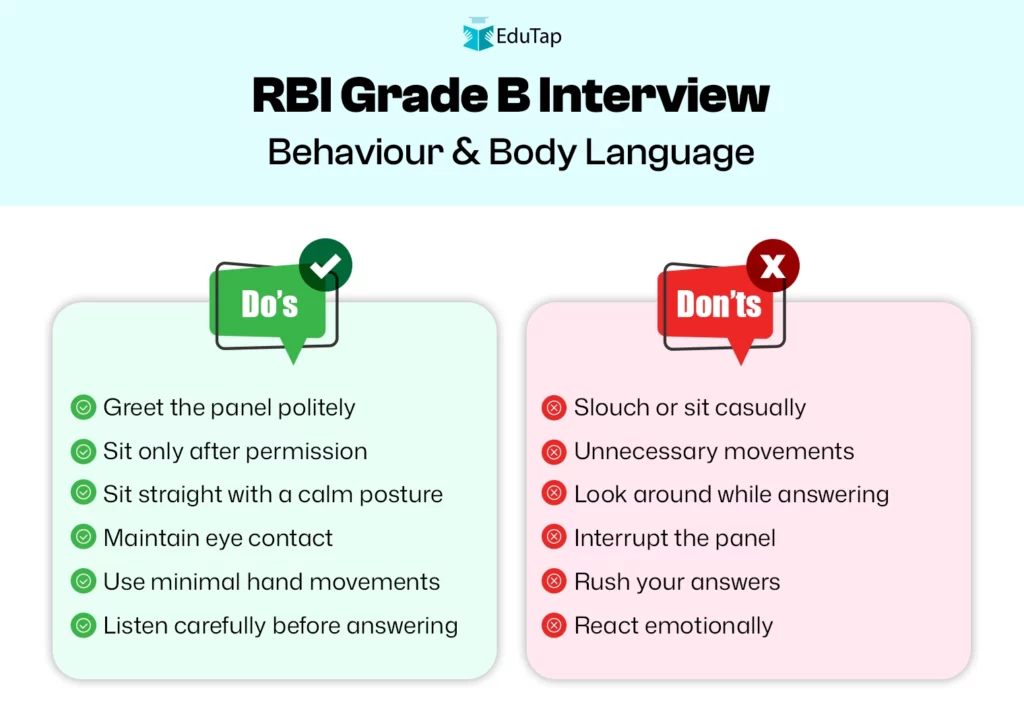
Do’s
- Greet the panel politely and wait for permission to sit.
- Sit straight with a comfortable and confident posture.
- Maintain natural eye contact while answering questions.
- Use minimal and controlled hand movements while speaking.
- Listen carefully and answer only after the panel finishes speaking.
- Keep your facial expressions calm and attentive.
Don’ts
- Do not slouch or sit in a casual manner.
- Avoid touching your face, hair, or pen repeatedly.
- Do not look around the room while answering questions.
- Avoid interrupting the panel or speaking over them.
- Do not react emotionally to difficult or unexpected questions.
- Avoid rushing your answers or speaking too fast.
- Mock Interview
- Online & Offline Options
- Experienced Panel
- Email & Phone Support
RBI Grade B Interview Questions
Understanding the types of questions asked in the RBI Grade B interview helps in focused and effective preparation. Although the RBI does not officially publish interview questions, candidates can prepare by learning from real interview experiences shared by past aspirants.
Where Can You Access the RBI Grade B Interview Transcripts?
RBI Grade B interview transcripts are available on:
- Trusted preparation platforms
- Coaching institute websites
- Online forums where candidates share their interview experiences
Download RBI Grade B Interview Transcripts
You can download the RBI Grade B Interview Transcripts shared by actual aspirants to get a practical understanding of the interview process.
Important Note:
- The transcripts only capture the questions asked and the candidate’s experience.
- They do not contain marks or official feedback from the interview panel.
Do RBI Grade B Interview Transcripts Help in Preparation?
Yes, RBI Grade B interview transcripts are helpful when used in the right way.
How Interview Transcripts Help?
- Help you understand the type of questions asked by the board
- Show the common areas from which questions are asked
- Give an idea of follow-up and cross-questions
- Help you practise structured and clear answers
How to Use RBI Grade B Interview Transcripts Effectively?
- Use transcripts to identify question patterns, not to memorise answers
- Practise answering similar questions in your own words
- Focus on improving clarity, logic, and confidence
What Are the Most Commonly Asked RBI Grade B Interview Questions?
While RBI does not publish official interview questions, based on candidate experiences and interview transcripts, the following questions are commonly asked in the RBI Grade B interview.
Questions About You (Biodata Form-Based)
- Tell us about yourself
- Questions from your
- Educational background
- Work experience (if any)
- Hobbies and interests
- What are your strengths and weaknesses?
Questions on RBI and Banking
- What are the main functions of RBI?
- How does RBI ensure financial stability?
- Recent RBI policies or initiatives
Questions on Economics, Finance, and Current Affairs
- Questions on inflation, growth, monetary policy, and fiscal policy
- Recent economic or financial developments in India
- Global events and their impact on the Indian economy
Questions on Motivation and Career Choice
- Why do you want to join RBI?
- Why RBI over private sector jobs or other government services?
HR and Behavioural Questions
- How do you handle pressure or stress?
- Describe a situation where you faced a challenge or conflict
- How would you respond to an ethical dilemma?
Opinion-Based and Situational Questions
- Your opinion on a current economic issue
- How would you handle a policy-related or workplace situation?
RBI Grade B Interview Board & Composition
The RBI Grade B interview process involves multiple interview boards. Here’s what you need to know:
Who Are the RBI Grade B Interview Board Members?
An RBI Grade B interview board typically consists of 4-5 members, including:
- Chairperson (usually a senior RBI official)
- Senior Government Officials, such as IAS, IFS, or other civil servants
- Subject Experts from fields like Economics, Finance, Banking, or Law
- HR or Behavioural Expert (may or may not be present in every board)
Key Points to Know About the Interview Board
- The Chairperson’s name is displayed at the interview venue.
- The names of other board members are not disclosed to candidates.
- Different candidates may face different boards, but evaluation standards remain uniform.
- Board members focus on concept clarity, attitude, and suitability, not just factual knowledge.
- Marks awarded by the board are not disclosed to candidates.
- You cannot choose or change your interview board.
Important Note:
- Candidates should not worry about the board composition. RBI ensures that:
- All boards follow standardised assessment criteria
- No board is tougher or easier than another
What is the RBI Grade B Interview Board Allocation Process?
- RBI does not publicly disclose how interview boards are allocated.
- The process is internal and appears to be random, ensuring fairness and uniform evaluation for all candidates.
Here is a summarized table of the above-mentioned information:
| RBI Grade B Interview Board & Composition | |
| Boards Count | Multiple |
| Members per Board | 4-5 members |
| Board Composition | Chairperson + civil servants + experts |
| HR Members | Not mandatory |
| Board Allocation | Random |
| Change Request | Not allowed |
| When do you know the Board? | On interview day (At the venue) |
- Mock Interview
- Online & Offline Options
- Experienced Panel
- Email & Phone Support
RBI Grade B Interview Centers
- The RBI Grade B interview is conducted at selected major cities in India, as decided by RBI.
Key Points
- Interview centers will be mentioned in the interview call letter.
- You cannot choose or change the interview centre.
- Online/remote interviews are not allowed.
- RBI does not provide accommodation for candidates.
- Drinking water is provided, but no other refreshments are available.
How to Reach the RBI Grade B Interview Location?
The exact interview center address is mentioned clearly in your interview call letter. You should plan your travel only after checking these details.
Simple Steps to Reach the Interview Location
- Check the full address and landmark mentioned in the call letter.
- Use Google Maps to locate the venue in advance.
- Check the schedule of public transport, such as the metro, bus, or local train.
- If travelling by cab or auto, share the exact venue name and address with the driver.
- Reach the venue 30-45 minutes before the reporting time to avoid delays.
If You Are Travelling from Another City
- Plan your travel and stay in advance once the interview location is announced.
- Choose accommodation close to the interview venue, if possible.
- Visit your venue a day before the interview, if possible.
Is There Any Travel Reimbursement for the RBI Grade B Interview?
- Yes. RBI provides travel reimbursement to candidates called for the Interview, as per the official notification.
How Much Reimbursement Will You Get?
- Reimbursement is limited to the to-and-fro AC Second Tier (2AC) railway fare.
- The fare is calculated by the shortest route from your residence to the interview venue.
Which Travel Modes are Eligible for Reimbursement?
- Eligible: AC Second Tier (2AC) railway travel
- Not Eligible: Any other mode of transport
How Long After the Interview is the Reimbursement Processed?
- The reimbursement is generally processed after the interview process is completed.
- The exact timeline may vary due to administrative procedures.
Will the Reimbursement be Provided in Cash or Credited Online?
- The amount is credited directly to your bank account.
- No cash payment is made at the interview venue.
Documents Required for Reimbursement
- Valid proof of 2AC railway ticket or fare receipt
- Interview call letter
- Bank account details
Important Notes:
- If you travel by air or bus, reimbursement will still be limited to the shortest-route 2AC railway fare. However, original travel proof must be submitted.
- If any information in the online application is found to be false or the eligibility criteria are not met, the candidature will be cancelled, and no interview or travel reimbursement will be allowed.
- Mock Interview
- Online & Offline Options
- Experienced Panel
- Email & Phone Support
RBI Grade B Pre-Interview Form – Biodata Form/DAF
Biodata form, also known as the Detailed Application Form, is the mandatory pre-interview form that must be filled out before the RBI Grade B interview.
How to Access and Submit the RBI Grade B Biodata Form/DAF
- The RBI Grade B Biodata Form is made available on the RBI official website along with the Phase 2 result.
- Shortlisted candidates must download the RBI Grade B Biodata form from the official RBI website.
- Carefully fill the form and submit its PDF along with scanned copies of the required certificates and documents.
- RBI provides a short submission window, usually 7–10 days, to complete and submit the DAF.
- Send the Biodata Form and documents only to: documentsrbisb@rbi.org.in.
- After submission, you’ll receive a confirmation email from RBI.
- Download and save a copy of the submitted DAF PDF for future reference and interview preparation.
What Details Are Asked in the RBI Grade B Biodata Form/DAF?
The Biodata form/DAF typically asks you to fill in the following details:
- Personal Information: Name, date of birth, and family details
- Address and Identity Details: Permanent and correspondence address and Valid ID details
- Educational Qualifications: Academic details from schooling to the highest qualification
- Work Experience: Past and current employment details (if applicable)
- Role, duration, and organisation details
- Category and Disability Details: Category and PwBD certificate (SC/ST/OBC/EWS), if applicable
- Photograph and Signature: As per the specified format and size
- Declaration: Confirmation that all information provided is true and correct

I’ve blurred the aspirant’s personal information to maintain confidentiality.
The image shown above is only a preview of the biodata form/DAF. Click on the link below to download the sample of the RBI Grade B Biodata Form/DAF .
Importance of RBI Grade B Biodata Form/DAF
The biodata form/DAF is extremely important for the interview because:
- It is used to evaluate your overall profile.
- The interview panel frames most questions directly from your biodata form/DAF.
- Any incorrect, false, or inconsistent information can negatively impact your interview and verification.
Documents Required for RBI Grade B Biodata Form/DAF Submission
You must upload clear scanned copies of the following documents:
- Valid ID proof
- 10th/12th certificates
- Degree certificate(s)
- Category/PwBD certificate (if applicable)
- Experience certificate (if mentioned)
Important Note: Carry all original documents to the interview venue for physical verification on the interview day.
Can Biodata Form/DAF Information Be Different from the Registration Form?
- Yes, changes are allowed, but only if genuinely required.
- Examples include:
- Address change
- Job change after registration
- Any change must be supported with valid documentary proof.
- Unexplained discrepancies can create verification issues.
Can You Edit the RBI Grade B Biodata Form/DAF After Submission?
- No, once the form is finally submitted, it cannot be edited.
- However, changes can be made while the form is in draft or preview mode.
- Candidates must review all details carefully before final submission.
Do’s & Don’ts of RBI Grade B Interview Biodata Form/DAF
Here are the do’s and don’ts of filling out the biodata from/DAF for the RBI Grade B interview:

Do’s
- Ensure all details match your supporting documents
- Check spellings, dates, and designations carefully
- Upload clear and readable scanned documents
- Be honest, factual, and concise
- Review the entire form before final submission
Don’ts
- Do not exaggerate achievements or experience
- Avoid contradictions across different sections
- Do not leave mandatory fields incomplete
- Do not upload unclear or irrelevant documents
- Avoid submitting the form at the last minute
RBI Grade B Interview Slots & Candidates
- There are 2 Interview slots for each day:
- Morning
- Afternoon
- A mid-day break is provided between the two sessions.
- Reporting time will be mentioned on your interview admit card.
- Arrive at least 30 minutes before your reporting time.
Do Interview Slots Remain the Same Every Year?
- The slot structure (morning/afternoon) generally remains the same.
- The number of interview days and boards may vary each year depending on:
- Number of vacancies
- Number of shortlisted candidates
How RBI Grade B Interview Slot Allotted?
- RBI does not publish any official rules for slot allotment.
- Based on past candidate experiences, slot allocation appears to be random.
- For each interview center, around 20 candidates are allotted per slot, making about 40 candidates per day.
- Requests for a change of slot are not accepted.
RBI Grade B Interview Order & Waiting Time
- Once a slot is allotted, your interview order is predefined.
- You cannot choose or change your interview sequence.
- Waiting time may range from a few minutes to a few hours, depending on:
- Your position in the interview list
- Speed of the interview board
- Number of candidates ahead of you
- A short break of 5–10 minutes is usually taken between two candidates.
After the RBI Grade B Interview
- Once your interview and document verification are completed, you are free to leave immediately.
- There is no requirement to wait until all interviews are over.
- Mock Interview
- Online & Offline Options
- Experienced Panel
- Email & Phone Support
Documents to Carry for the RBI Grade B Interview
You must carry the following documents on the RBI Grade B interview day:
- Printed Interview Call Letter (Admit Card)
- Printed copy of the Online Application Form
- Original Identity Proof
- Aadhaar Card / Passport / PAN Card / Voter ID / Driving Licence
- Passport-size photographs
- Same as used in the application (if mentioned in the call letter)
- Original Certificates (for Verification)
- Educational qualification certificates
- Category / PwBD certificate (if applicable)
- Experience certificate (if applicable)
- No Objection Certificate (NOC) (if applicable)*
- Photocopies & Stationery
- 2-3 sets of photocopies of all documents
- A pen for filling out forms at the venue
*NOC is required only for candidates working in government, quasi-government bodies, PSUs, public sector banks, or defence services.
Important Note:
- Late submission of documents is not accepted.
- All certificates will be verified on the interview day.
- Missing or incorrect documents may lead to disqualification.
Items Not Allowed at RBI Grade B Interview
The following items are strictly prohibited inside the interview centre:
- Mobile phones (even switched off)
- Smartwatches or digital watches (analog watch allowed)
- Books, notes, or written material
- Electronic gadgets (Laptops, earphones, tablets, calculators, power banks)
- Bags or backpacks
Important Note:
- You may carry a simple water bottle
- Drinking water is also available at the venue
- No refreshments (tea/snacks) are provided, so eat beforehand
Baggage & Accompanying Persons Rules
- No baggage deposit or locker facility is available at the venue.
- Avoid bringing bags or valuables, as RBI is not responsible for loss or damage.
- If required, make your own arrangements for storing belongings outside the venue.
- You may bring a family member or friend up to the main gate, but they are not allowed inside the interview premises.
What Next?
Now that you know the RBI Grade B interview process, here’s what to do next:
- Fill and revise your DAF, as most interview questions will be based on it.
- Strengthen clarity on RBI’s role, core economics, finance, and current affairs from an applied perspective.
- Practise structured answers for HR, behavioural, and opinion-based questions.
- Read newspapers daily, especially in the weeks leading up to the interview.
- Prepare documents in advance and plan your travel to the interview centre early.
- Consider mock interviews or expert feedback to refine confidence, body language, and answer delivery.
Remember, the RBI Grade B interview is not about memorising answers. It is about clarity of thought, honesty, composure, and suitability for a regulatory role.