The SBI PO exam pattern for 2026 has three phases: Prelims, Mains, and a Phase 3 round that combines a Psychometric Test, Group Exercise, and Interview.
Understanding the SBI PO prelims pattern and the SBI PO mains pattern as well as the interview separately is essential because each stage tests different things and has different rules.
This article covers the complete SBI PO exam pattern 2026: section-wise marks, time limits, negative marking, descriptive test, psychometric test, group exercise, interview, and how the final merit is calculated.
What are the SBI PO 2026 Exam Stages?
According to the official SBI PO notification, the selection procedure of the SBI PO 2026 exam is:
- Phase 1 (Pre)
- Phase 2 (Mains)
- Phase 3 (Interview)
- Prelims PYQs
- Mains PYQs
- Section Wise Questions
- Answer Keys
What is the SBI PO Prelims Exam Pattern?
The SBI PO preliminary exam pattern is an online objective test. Candidates are required to tick the right answers on a computer screen.
| SBI PO 2026 Prelims Pattern | |||
| Subject | Questions | Marks | Duration |
| Reasoning Ability | 30 | 30 | 20 minutes |
| English | 40 | 40 | 20 minutes |
| Quantitative Aptitude | 30 | 30 | 20 minutes |
| Total | 100 | 100 | 60 minutes |
Important Note: PwBD candidates, with 40% or more disability, who have physical limitations to type/write including that of speed shall be allowed compensatory time of 20 minutes per hour of the examination whether availing the facility of a scribe or not.
Key Rules of SBI PO Prelims
- Each section has a separate time limit of 20 minutes. Time cannot be carried over from one section to another.
- No sectional cut-off. Only an overall aggregate cut-off applies.
- Negative marking is 1/4th of the question’s marks per wrong answer.
- Marks per question are 1 mark each.
- It is an online computer-based test.
- The exam is offered in Hindi and English languages, except for the English Language test which is solely in English.
Is SBI PO Prelims Qualifying in Nature?
Yes. Prelims is purely qualifying. The marks scored in Prelims are not added to the final merit list.
They are only used to draw the category-wise merit list for shortlisting to Mains.
How Many Candidates are Shortlisted for SBI PO Mains?
Approximately 10 times the number of vacancies in each category, from the top of the Prelims merit list.
For example, with 1,500 vacancies in 2026: approximately 15,000 candidates (across categories) are shortlisted for Mains.
Sectional Cut-Off in SBI PO Prelims
Not Applicable. A candidate can score zero in one section and still clear Prelims, as long as the overall aggregate is above the cut-off.
However, this strategy carries high risk since marks per question are equal across sections.
Candidates who achieve the minimum qualifying marks (overall as well as section-wise) set by SBI in the Prelims exam are eligible to appear for Phase 2 (Mains).
| SBI PO 2026 Prelims Pattern Additional Details | |
| Mode | Online |
| Paper Structure | Objective-Type (MCQs) |
| Nature | Qualifying |
| Language | Hindi & English (Except the test of English) |
| Total Number of Questions | 100 |
| Total Marks | 100 |
| Overall Cut-Off Marks | Decided as per the calling ratio |
| Sectional Cut-Off Marks | No |
| Negative Marking | 0.25 (1/4th for every wrong answer) |
| Total Duration | 1 Hour |
| Sectional Timing | Yes |
Find the right tips to customize your own SBI PO preparation strategy.


- Prelims PYQs
- Mains PYQs
- Section Wise Questions
- Answer Keys
What is the SBI PO Mains Exam Pattern?
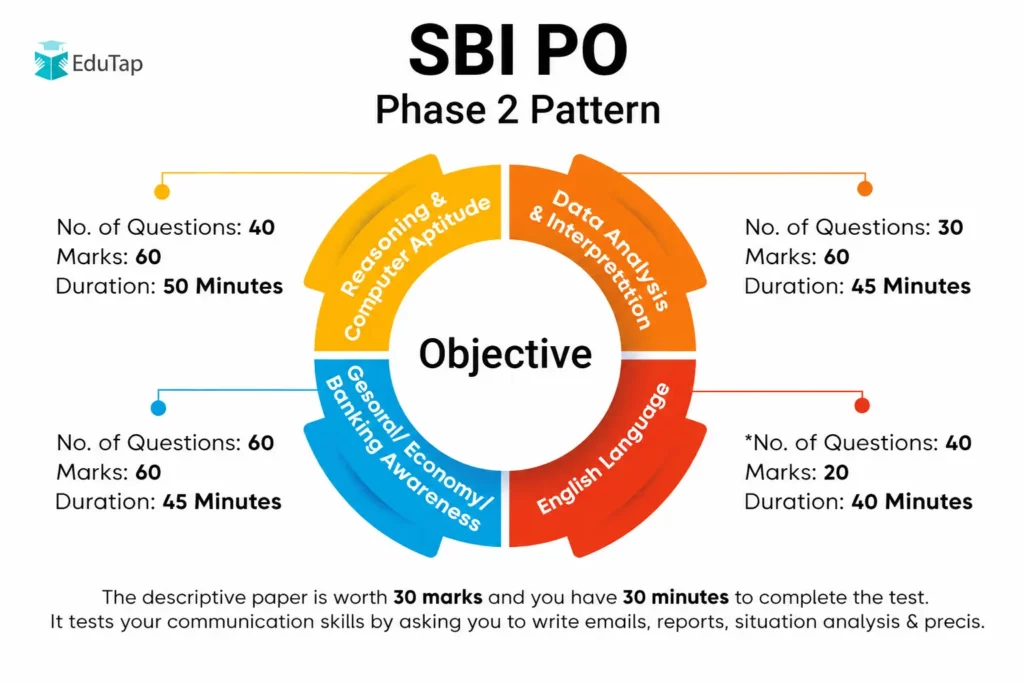
The SBI PO mains pattern has two parts: an Objective Test and a Descriptive Test.
As per the official notification, here is the SBI PO mains pattern:
| SBI PO 2026 Mains Pattern | ||||
| Test | Subject | Questions | Marks | Duration |
| Objective | Reasoning & Computer Aptitude | 40 | 60 | 50 Minutes |
| Data Analysis & Interpretation | 30 | 60 | 45 Minutes | |
| General/Economy/Banking Awareness | 60 | 60 | 45 Minutes | |
| English Language | 40 | 20 | 40 Minutes | |
| Total | 170 | 200 | 3 Hours | |
| Descriptive | Communication Skills 3 questions: Emails (1 out of 2 options) Situation Analysis (1 out of 2 options) Either Report Writing or Precis Writing (1 out of 2 options) | 3 | 30 | 30 Minutes |
| Total | 230 | |||
Important Note: PwBD candidates, with 40% or more disability, who have physical limitations to type/write including that of speed shall be allowed compensatory time of 20 minutes per hour of the examination whether availing the facility of a scribe or not.
Key Rules for the Objective Test
- Each section has its own time limit. Time cannot be carried over.
- Sectional cut-offs apply. Each section must be cleared individually.
- Negative marking is 1/4th of the question’s marks per wrong answer.
- Marks per question are not uniform. Reasoning (1.5 per Q), DI (2 per Q), GA (1 per Q), English (0.5 per Q).
- No option to skip between sections once section time starts.
- The exam is offered in Hindi and English languages, except for the English Language test and descriptive paper, which are solely in English.
Reasoning and Computer Aptitude
- 40 questions for 60 marks.
- Each question carries 1.5 marks.
- Covers Puzzles, Seating Arrangement, Syllogism, Input-Output, Coding-Decoding, Blood Relations, Directions, Computer Aptitude basics.
Data Analysis and Interpretation
- 30 questions for 60 marks.
- Each question carries 2 marks. Highest marks per question in the paper.
- Covers Data Interpretation (tables, bar charts, pie charts, line graphs, caselets), Quantitative topics, Data Sufficiency.
General Awareness / Economy / Banking Knowledge
- 60 questions for 60 marks.
- Each question carries 1 mark.
- Covers Current Affairs (last 6 months), Banking Awareness, Economy and Finance, Static GK.
English Language
- 40 questions for 20 marks.
- Each question carries only 0.5 marks.
- Covers Reading Comprehension, Para Jumbles, Cloze Test, Error Detection, Vocabulary
Sectional Cut-Off in Mains
Yes. Unlike Prelims, Mains has both sectional cut-offs and an aggregate cut-off.
Candidates who clear the aggregate but fail any section’s cut-off are not shortlisted for Phase III.
What is the SBI PO Descriptive Test Pattern?
The Descriptive Test is conducted immediately after the Objective Test as part of Mains.
Is the Descriptive Test compulsory?
Yes. Every candidate who sits for Mains must attempt the Descriptive Test.
However, the Descriptive paper is evaluated only if the candidate has cleared the Objective Test cut-offs (sectional and aggregate).
Type of Questions Asked
Candidates choose 1 out of 2 options for each of the following three types:
- Email writing: Write a formal or semi-formal email on a given situation
- Situation Analysis: Analyse a given situation and present a structured response
- Report Writing or Precis Writing: Either write a short report on a given topic, or summarise a passage in a precis
Marks Distribution
The notification does not specify individual marks per question. The total is 30 marks for all three components combined.
How is Descriptive Test Evaluated?
Manually by evaluators appointed by SBI. The Bank has stated that Descriptive papers may also be assessed using automated evaluation tools.
- Prelims PYQs
- Mains PYQs
- Section Wise Questions
- Answer Keys
How Many Candidates are Shortlisted for Phase III?
Approximately 3 times the number of vacancies in each category from the Mains merit list.
| SBI PO 2026 Mains Pattern Additional Details | |
| Mode | Online |
| Language | Hindi & English (Except for the test of English Language and Descriptive Paper) |
| Total Marks | 300 |
| Cut-Off Marks | Decided as per the calling ratio |
| Sectional Cut-Off Marks | No |
| Negative Marking (Objective questions) | 1/4th |
Candidates who qualify in SBI PO Phase 2 are then shortlisted for a psychometric test, group discussion, and interview. This stage evaluates the candidate’s knowledge, skills, and suitability for the SBI Probationary Officer role.

- Prelims PYQs
- Mains PYQs
- Section Wise Questions
- Answer Keys
What is the SBI PO Phase 3 Pattern?
The SBI PO Phase 3 consists of a Psychometric Test, Group Exercise & Interview.
What is the SBI PO Psychometric Test Pattern?
The Psychometric Test is a new component in SBI PO Phase III, added in recent cycles. It is non-scoring, which means scores are not given for this round.
It is a personality profiling/self-report assessment round proctored online or at identified examination centres.
Is it Qualifying?
No. Your psychometric score does not add to the final merit. But you must appear for it. If you do not appear, you are ineligible for the Group Exercise and Interview.
How are Psychometric Results Used?
The findings of the test are placed before the Interview panel. This means the panel will have your personality profile when they interview you. They may use it to frame situational and behavioural questions.
Type of Questions
Typically Likert scale statements where you rate how much you agree or disagree.
Example: “I prefer working in a structured environment” — Strongly Agree / Agree / Neutral / Disagree / Strongly Disagree.
Duration
Typically takes 20 to 40 minutes based on past candidate experiences.
What is the SBI PO Group Exercise Pattern?
| SBI PO Group Exercise Pattern | |
| Parameter | Details |
| Marks | 20 |
| Format | Group discussion and analysis on a given topic |
| Evaluation | By a panel of observers |
Is Group Exercise the Same as Group Discussion (GD)?
Not exactly. SBI PO uses the term “Group Exercise,” which may involve:
- A topic-based discussion where all participants share views.
- A case study where the group is given a problem to solve collectively.
- A role-play or structured group task.
The exact format can vary by batch and centre. In practice, it closely resembles a traditional Group Discussion but may involve more structured tasks.
Topic Given for Discussion
Topics are current affairs, banking sector issues, social issues, or general management themes.
Examples from past cycles include financial inclusion, digital banking adoption, and economic issues.
Duration of Group Exercise
Typically 15 to 20 minutes per group based on past candidate experience.
Number of Candidates Per Group
Typically 8 to 12 candidates per group based on past batches.
What is Evaluated?
- Communication skills: Clarity, fluency, confidence.
- Leadership: Ability to initiate, guide, and conclude discussion.
- Team Participation: Listening, building on others’ points, not dominating.
- Subject Knowledge: Awareness of the topic being discussed.
- Composure: Handling disagreement without aggression.
- Prelims PYQs
- Mains PYQs
- Section Wise Questions
- Answer Keys
What is the SBI PO Interview Pattern?
| SBI PO Interview Pattern | |
| Parameter | Details |
| Marks | 30 |
| Minimum qualifying marks | Decided by the Bank |
| Panel | Typically 3 to 5 senior SBI/panel officers |
Type of Questions Asked
Banking and Current Affairs Questions
- Repo rate, reverse repo, CRR, SLR, bank rate current values and their purpose
- Recent monetary policy decisions by RBI
- Recent developments in the banking sector
- Government schemes linked to banking and finance
- Budget highlights and economic indicators (GDP, inflation, fiscal deficit)
Personal Background and HR questions
- Tell me about yourself
- Your educational background and graduation subject
- Work experience if any
- Why banking as a career?
- Why SBI specifically?
Situational and Behavioural Questions
- If a customer is aggressive about a transaction dispute, how do you handle it?
- If your manager gives you an instruction that seems incorrect, what do you do?
- Describe a time when you worked under pressure.
- What are your strengths and weaknesses?
Questions on SBI PO Role and Responsibilities
- What does a Probationary Officer do in the first year?
- What is SBI’s recent initiative on [relevant banking topic]?
- What is your understanding of priority sector lending?
- How would you handle an NPA-related query from a borrower?
Interview Duration:
Typically 10 to 20 minutes per candidate. Not fixed. Varies by panel and candidate.
For a detailed syllabus, click on the link: SBI PO Syllabus.
How is the SBI PO Final Merit List Prepared?
The final merit list is based on Mains (Phase II) and Phase III combined. Prelims marks are not included.
Marks scored in Phase II (out of 230) are converted to a score out of 75. Marks scored in Phase III (out of 50) are converted to a score out of 25. These are then added for a final score out of 100.
| SBI PO Actual Marks & Normalised Marks | ||
| Stage | Actual Marks | Normalised To |
| Mains: Objective + Descriptive | 230 | 75 |
| Phase III: GE + Interview | 50 | 25 |
| Final Score | 100 | |
Tie Breaking
If two candidates have the same final marks at the cut-off, they are ranked in descending order of age (older candidate ranked higher).
- Prelims PYQs
- Mains PYQs
- Section Wise Questions
- Answer Keys
How does the SBI PO Exam Pattern Compare with IBPS PO?
| SBI PO vs IBPS PO Exam Pattern | ||
| Parameter | SBI PO | IBPS PO |
| Prelims sections | English 40Q, QA 30Q, Reasoning 30Q | English 30Q, QA 35Q, Reasoning 35Q |
| Prelims marks | 100 | 100 |
| Mains objective | 170 Q, 200 marks, 3 hrs | 170 Q, 200 marks, 3 hrs |
| Mains GA section | 60 Q, 60 marks | 50 Q, 60 marks |
| English in Mains | 40 Q, 20 marks | 40 Q, 20 marks |
| DI/Quant in Mains | 30 Q, 60 marks | 40 Q, 60 marks |
| Descriptive paper | Email + Situation Analysis + Report/Precis | Essay + Comprehension |
| Phase III | Psychometric + GE (20M) + Interview (30M) | Psychometric + Interview (30M) only |
| Group Exercise | Yes (20 marks) | No |
| Personality Test | Yes, non-scoring | Yes, non-scoring |
| Computer Aptitude | Yes, part of Reasoning section | No (2026 pattern) |
| Final merit | Mains 75% + Phase III 25% | Mains 80% + Phase III 20% |
Which Exam is Tougher?
SBI PO is generally considered more competitive. Reasons:
- Only one bank (SBI), so prestige is higher, drawing stronger candidates.
- Group Exercise adds one more evaluation layer vs IBPS PO.
- SBI PO Descriptive has 3 components vs IBPS PO’s 2.
- Historically, SBI PO Prelims cut-offs are higher than IBPS PO for the General category.
- Final weightage gives Mains 75% in SBI PO vs 80% in IBPS PO. Interview carries more weight in SBI PO (25% vs 20%).
How does the SBI PO Exam Pattern Compare with SBI Clerk?
| SBI PO vs SBI Clerk Exam Pattern | ||
| Parameter | SBI PO | SBI Clerk |
| Number of stages | 3 (Prelims, Mains, Phase III) | 2 (Prelims, Mains) |
| Prelims sections | 3 sections, 100 marks | 3 sections, 100 marks |
| Prelims English | 40 Q | 30 Q |
| Prelims QA | 30 Q | 35 Q |
| Prelims Reasoning | 30 Q | 35 Q |
| Prelims duration | 1 hour | 1 hour |
| Mains sections | 4 + Descriptive | 4 + General English (qualifying) |
| Mains total marks | 230 | 200 |
| Mains DI | 30 Q, 60 marks | 50 Q, 50 marks |
| Computer Aptitude | Part of Reasoning in Mains | Separate section in Mains |
| Descriptive test | Yes (30 marks) | No |
| Group Exercise | Yes (Phase III) | No |
| Interview | Yes (Phase III) | No |
| Difficulty | Higher | Lower |
Which Exam is Tougher?
SBI PO is significantly tougher. It has one more stage (Phase III with GE and Interview), a Descriptive paper, and a Mains that tests more sections at greater depth.
SBI Clerk Mains does not have a Descriptive paper or an interview.
- Prelims PYQs
- Mains PYQs
- Section Wise Questions
- Answer Keys
SBI PO Exam Pattern 2026: Final Thoughts
Understanding the SBI PO exam pattern 2026 provides a roadmap for your preparation. This knowledge empowers you to start your preparation journey with confidence. By familiarizing yourself with the latest requirements, you can:
- Choose the right study materials.
- Prioritize high-weightage sections.
- Develop a focused study plan.