Knowing how to prepare Labour Codes for UPSC EPFO exam is important because it is a core part of the Recruitment Test syllabus.
The UPSC EPFO APFC 2026 syllabus now specifically includes Industrial Relations, Labour Codes and Social Security in India.
With the four Labour Codes coming into force from 21 November 2025, candidates should focus on the current Labour Code framework rather than preparing the old labour Acts as the primary syllabus.
This article covers the Labour Codes syllabus, PYQ trends, a 25-day study plan, UPSC EPFO preparation sources, revision strategy and important topics for UPSC EPFO.
- Syllabus
- Previous Year Papers
- Preparation Sources
- Strategy
Syllabus of Labour Law for UPSC EPFO 2026
There is no separate official Labour Law syllabus in the UPSC EPFO notification. The topics below have been identified based on PYQ analysis and past exam trends.
The table below also lists the only source needed for Labour Law preparation.
| UPSC EPFO EO/AO & APFC Labour Law (LL) Syllabus 2026 | |
| Topics | Code on Social Security, 2020 Code on Wages, 2019 Industrial Relations Code, 2020 Occupational Safety & Working Conditions Code, 2020 The four Codes rationalise 29 Central labour laws, so candidates should understand both the provisions of each Code and the major changes introduced by the new framework. |
| Source | * Refer to the website of the Ministry of Labour and Employment * Go to the “ Document” tab and click on “Acts & Policies” * A list will appear. Look for the 4 Codes from the list & study from there only. |
Key Points
- Labour Codes are a core part of the current UPSC EPFO syllabus.
- Focus on the four Labour Codes and their important provisions.
- Pay special attention to definitions, thresholds, authorities, penalties, social-security provisions and key changes.
- Use previous-year questions to identify the areas that need deeper revision.
- Syllabus
- Previous Year Papers
- Preparation Sources
- Strategy
Should You Study Old Labour Laws for UPSC EPFO 2026?
The Labour Codes should be your primary focus.
The four Labour Codes came into force on 21 November 2025, replacing/rationalising the framework of 29 Central labour laws.
Therefore, candidates should first understand the provisions of the four current Labour Codes rather than spending most of their preparation time studying the old Acts separately.
However, knowing the major Acts subsumed by each Code can still help you understand where provisions have come from and identify changes between the earlier and current framework.
Labour Law for UPSC EPFO 2025: PYQ Analysis
Analysis of the last 5 years of question papers shows that Labour Law questions have increased in frequency and difficulty.
The 2025 exam saw a significant shift: all Labour Law and Industrial Relations questions came exclusively from Labour Law.
Zero questions appeared from Industrial Relations. The tables below capture the full PYQ trend for EO/AO and APFC.
| UPSC EPFO EO/AO PYQ Analysis Labour Law (LL) | ||
| Year | Number of Questions Asked | Difficulty level |
| 2017 | 8 | Moderate |
| 2021 | 16 | Moderate |
| 2023 | 15 | Difficult |
| 2025 | 6 | Difficult |
| UPSC EPFO APFC PYQ Analysis Labour Law (LL) | ||
| Year | Number of Questions Asked | Difficulty level |
| 2015 | 5 | Moderate |
| 2023 | 14 | Difficult |
| 2025 | 6 | Difficult |
Download the solved PYQs from the UPSC EPFO previous year question papers page.
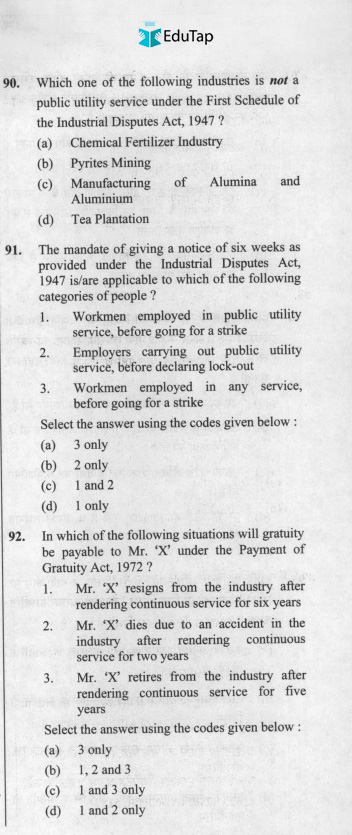
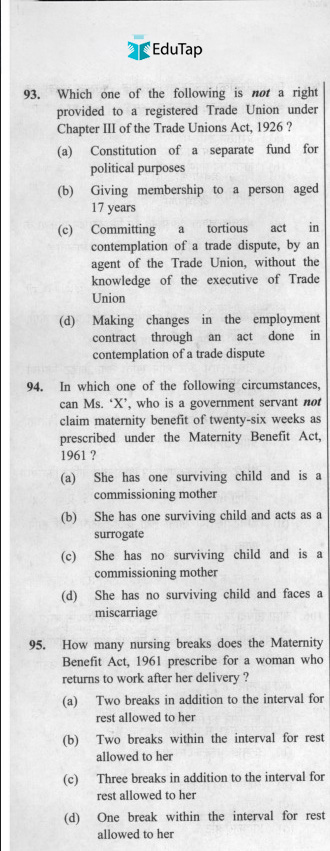
Here are all the Labour Law questions that appeared in the UPSC EPFO 2025 exam:
Is Self-Study Enough for Labour Codes for UPSC EPFO?
Yes. Labour Codes for UPSC EPFO is one of the most self-study-friendly subjects in the entire syllabus.
The source is free and accessible, and the questions are entirely fact-based. No analytical depth is required.
- Syllabus
- Previous Year Papers
- Preparation Sources
- Strategy
25-Day Study Plan for Labour Law for UPSC EPFO 2026
The plan below allocates 2 hours per day across 25 days to cover the complete UPSC EPFO Labour code syllabus.
Each day maps to a specific Act with tasks to complete.
| UPSC EPFO Labour Codes 25-Day Study Plan | ||
| Day | Act/Topic | Tasks |
| 1-2 | Code on Wages | Key definitions, wages, minimum wages, floor wage |
| 3 | Code on Wages | Payment of wages, deductions, claims and authorities |
| 4 | Code on Wages | Bonus, equal remuneration, penalties + MCQs |
| 5-6 | Industrial Relations Code | Trade unions, registration, negotiating union/council |
| 7 | Industrial Relations Code | Standing orders and applicability |
| 8-9 | Industrial Relations Code | Strikes, lockouts, retrenchment, lay-off and closure |
| 10 | Industrial Relations Code | Industrial disputes, authorities, tribunals + MCQs |
| 11-12 | Social Security Code | EPF, ESI and major social-security provisions |
| 13 | Social Security Code | Gratuity, maternity benefit and employee compensation |
| 14 | Social Security Code | Unorganised, gig and platform workers |
| 15 | Social Security Code | Social Security Fund, authorities, schemes + MCQs |
| 16-17 | OSHWC Code | Registration, duties, health, safety and welfare |
| 18 | OSHWC Code | Working hours, leave and employment conditions |
| 19 | OSHWC Code | Contract labour and inter-State migrant workers |
| 20 | OSHWC Code | Women workers, occupational safety, offences and penalties |
| 21 | Code Comparison | Compare the four Codes and major provisions |
| 22 | Old Laws → Codes | Revise major Acts subsumed under each Code |
| 23 | PYQs + MCQs | Solve Labour Law/Codes questions from UPSC and related exams |
| 24 | Weak Areas | Revise definitions, thresholds, authorities and penalties |
| 25 | Full Revision Test | Attempt a mixed Labour Codes test and analyse mistakes |
How to Make Notes for Labour Codes?
Create a one-page note per Act with this format:
- Act Name + Year
- Applicability – which establishments, number of workers, and industries
- Key Definitions – “worker”, “wages”, “factory”, “employer” as defined in that Act
- Core Provisions – the 3 to 5 sections most likely to be tested
- Key Thresholds – numbers, percentages, timeframes (e.g., Bonus = 8.33% minimum, 20% maximum)
- Penalties – imprisonment, fines, employer liability
- Authorities – who enforce, who adjudicate
Should the Notes be Handwritten or Digital?
Both work. Handwritten notes improve retention during initial study. Digital notes are faster to revise later.
Use whichever you are comfortable with.
How Difficult is Labour Codes for UPSC EPFO?
Labour Law is moderately difficult but completely manageable.
Can Non-Law Students Prepare Labour Codes for EPFO?
Yes. The UPSC EPFO questions do not test legal interpretation or case law reasoning. They test:
- Specific thresholds (e.g., minimum wage fixation periods, penalty amounts)
- Definitions under Acts (e.g., “worker”, “factory”, “wages”)
- Key provisions (e.g., permissible deductions, grounds for layoff)
- Employer duties and timeframes
None of this requires a law degree. What it requires is reading the Bare Act carefully, once, and making short notes.
How Deep should Labour Codes Preparation be?
You do not need to read commentary books or legal interpretations.
What you need:
- Full text of each Act from the Ministry of Labour website
- Focus on: definitions, key sections, penalties, thresholds, authorities
- Skip: preamble history, lengthy schedules unless specifically tested
What you do not need:
- Court judgments
- Legal commentary
- Law textbooks
Is Rote Learning Enough for Labour Codes?
No. Rote learning without understanding will fail in statement-based and scenario questions.
In 2023 and 2025, UPSC asked questions where multiple statements were given about a provision, and candidates had to identify which ones were correct.
Pure memorisation without understanding the provision logic gets these wrong.
A better approach would be to read each section, understand what it says in plain language, and then make a one-line note. This is faster and more durable than memorising text.
Which Labour Codes are Most Important for UPSC EPFO?
All four Labour Codes are important for UPSC EPFO. However, candidates should give additional attention to topics that directly connect with EPFO’s work and have strong conceptual or factual depth.
- Code on Social Security, 2020
- EPF
- ESI
- Gratuity
- Maternity benefit
- Gig/platform workers
- Social security schemes
- Industrial Relations Code, 2020
- Trade unions
- Standing orders
- Strikes/lockouts
- Retrenchment
- Lay-off
- Industrial disputes
- Code on Wages, 2019
- Minimum wages
- Floor wage
- Payment of wages
- Deductions
- Bonus
- Equal remuneration
- OSHWC Code, 2020
- Safety and health
- Working conditions
- Contract labour
- Migrant workers
- Working hours
- Welfare provisions
- Syllabus
- Previous Year Papers
- Preparation Sources
- Strategy
How to Revise Labour Codes Effectively?
A minimum of 3 revisions before the exam:
- Revision 1: Revise each Code after completing it. Focus on definitions, provisions, thresholds and authorities.
- Revision 2: After completing all four Codes, revise them together and compare similar provisions.
- Revision 3: In the final week, revise only your short notes, important figures, penalties, authorities and PYQ-based facts.
If your notes are ready, one week of focused revision can be used to revise the four Labour Codes and your PYQ-based notes.
Does UPSC Ask Current Affairs from Labour Codes?
Rarely. But recent amendments and notifications may appear.
What to Look For:
- Updates related to minimum wage revision (scheduled wage revision cycles).
- Notifications under Old Acts and New Labour Codes.
- Any major Supreme Court ruling on Labour Law (especially on ID Act).
For current affairs in Labour Laws, follow:
- Labour Ministry press releases on Labour Ministry.
- Monthly current affairs from a reliable source.
Do not dedicate more than 30 minutes weekly to this. The base content (Bare Acts) is far more important.
Common Mistakes to Avoid in UPSC EPFO Labour Laws Preparation
- Preparing old Acts as the primary syllabus: Use the current Labour Codes as your main source and study the older Acts mainly to understand the transition and major changes.
- Reading all four Codes without making comparisons: Similar concepts appear across Codes. Use comparison tables to avoid mixing them up.
- Ignoring definitions and thresholds: UPSC can test specific provisions, numbers and applicability conditions.
- Skipping Social Security provisions: EPF-related provisions and broader social-security concepts are especially important for EPFO aspirants.
- Not solving PYQs: Use PYQs from UPSC EPFO and relevant labour-related examinations to identify recurring concepts.
- Relying only on current affairs: Current affairs should supplement your understanding of the Codes, not replace static preparation.
- Doing only one revision: Similar provisions across the Codes can easily get mixed up without repeated revision.